Protein Crystallography and
Biophysics Centre (BiophysX)
Institute of Structural and Molecular Biology
(ISMB)
Birkbeck College / University College London
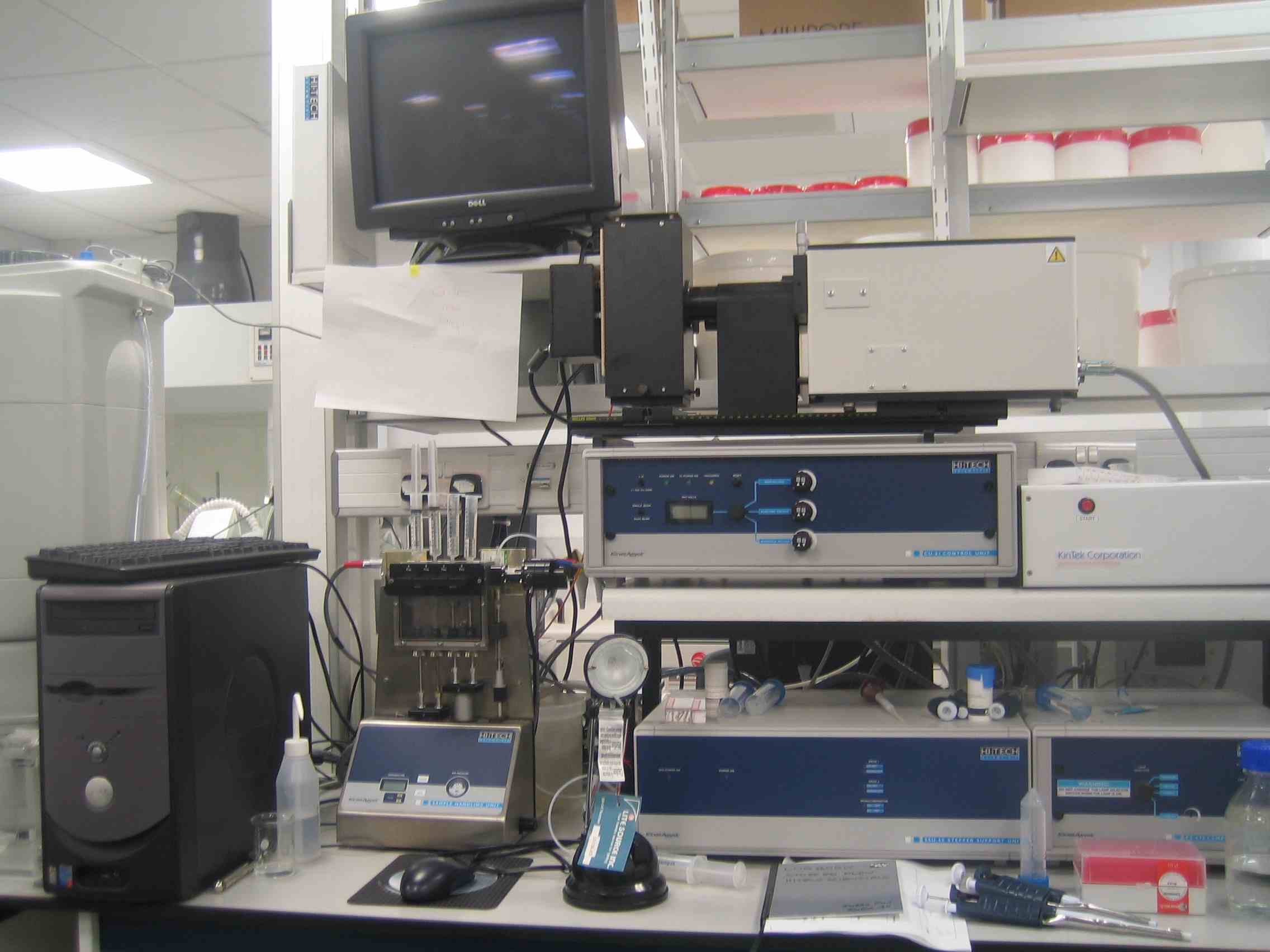
Our KinetAsysT can measure
UV/Vis absorption, single or
dual-channel fluorescence with a
dead time of 1 to 2
milliseconds. Many enzymes,
other macromolecules, substrates
or products are optically active
or fluorescent. Using this to
measure rapid reaction kinetics
can be critical to understand
enzyme mechanism, ligand binding
or the folding or assembly of
complexes. The dual-channel
setup allows FRET measurement
and therefore distance
measurements between fluorescent
labels before and after a
conformational change.
Various size syringes are
available to allow mixing at
different ratios. Double-mixing
of samples is also possible to
further investigate reactions of
more than one step. The syringes
and optical cell are immersed in
a thermostatted waterbath
allowing choice of reaction
temperature.
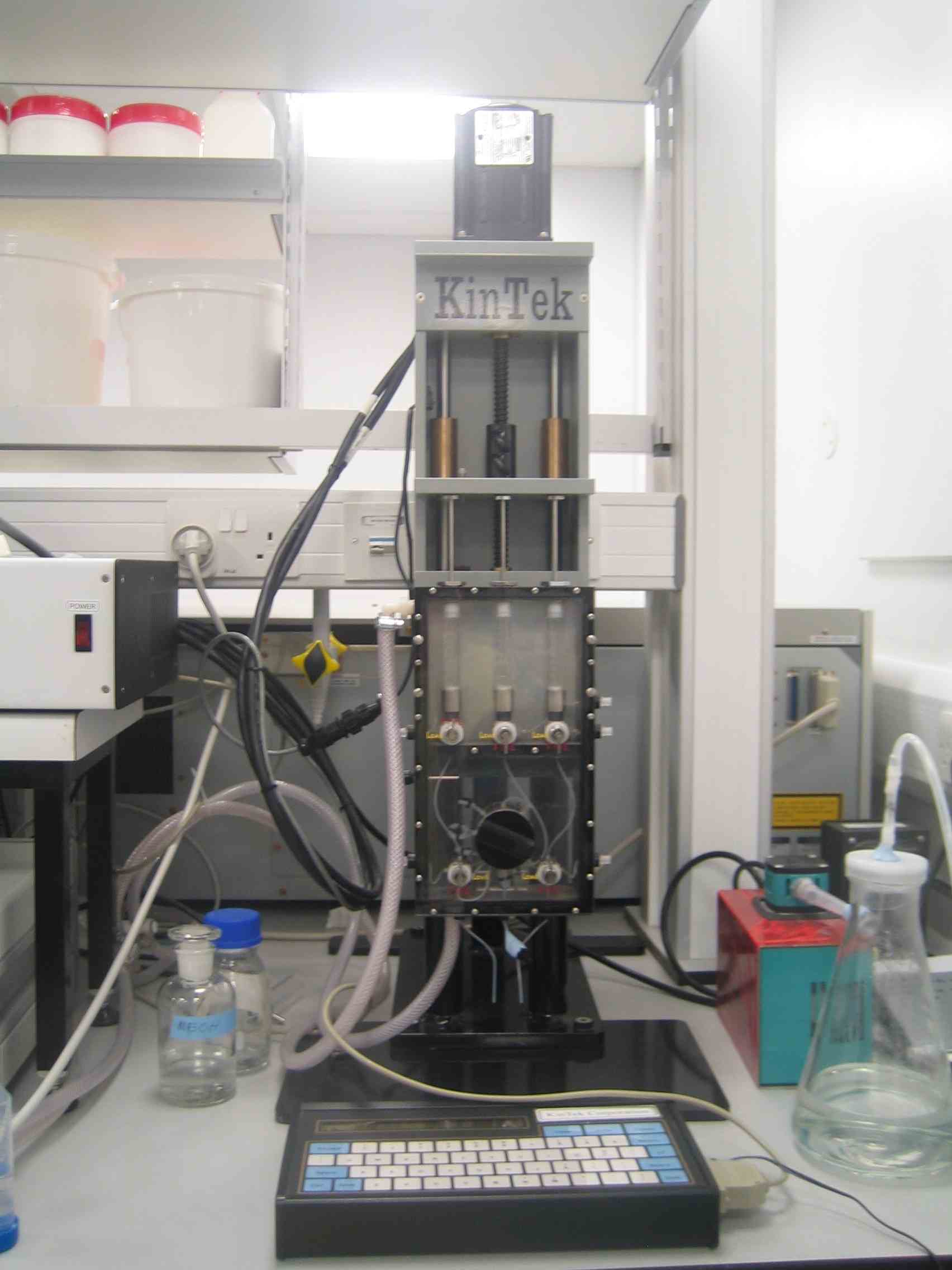
Quench-Flow
(RQF-3, Kintek)
A quench-flow
apparatus enables rapid stopping of
a reaction by adding a chemical
quenching agent to the reaction
mixture. The shortest time points
accessible lie in the range of
milliseconds, so even the fastest
reaction rates become accessible.
The quench-flow is especially used
for establishing single-turnover
rates of enzyme-catalysed reactions
when no optical probe is available
and for isolating intermediate
species.
The RQF-3 requires as little as 15
microlitres per timepoint. It
produces the quenched samples that
will then have to be analysed by an
independent method. For example,
there is a HPLC at the centre which
may be used to determine the
quantities of substrate and products
in those samples.
Please contact us for
detailed protocols and planning your
experiment.